Hell in Playland
Figuration and Reconfiguration in the Mission
"Art has always been the raft onto which we climb to save our sanity. I don't see a different purpose for it now [post 9/11]"--Surrealist painter Dorothea Tanning, 2002
Note: Norm's Market refers to the mural by Sirron Norris located at 20th and Bryant Streets; "Generator" refers to the mural by Andrew Schoultz and Aaron Noble on Lexington Street at 18th Street. Both are located in San Francisco's Mission District.

If 20th century painter Francis Bacon's figures are, as philosopher Gilles DeLeuze wrote, trying to escape through the drainpipes, then these murals are where they emerge. These muralists turn Bacon's extremely personal expression inside-out and echo many artistic movements to deploy humor, graphic style and direct social commentary. They take it all a step further by painting in context-- on the walls of the very neighborhoods in which the scenarios are lived out. Andrew Schoultz and Sirron Norris have used compositional structures parallel to Bacon's to employ figuration; they portray buildings as figures resting on floating platforms, stages on which they, like Bacon's meaty figures, perform as characters. These muralists invert Bacon's compositional approach by depicting infrastructures or places which consume rather than support the protagonists. Bacon's exquisitely ordered compositions dignified the pain of the Human Condition by staging brutally emotive figures on oval supports against lovely color fields. Schoultz, Sirron and Noble have similarly employed this tension between beauty and horror by using the cute appeal of cartoons and comics to frame an apocalyptic vision. Like Bacon, they use technical mastery and sharp stylizing to communicate pathos. This crispness creates a blur by masking the dark underlying meaning. In place of the corporeal dynamism of Bacon's bodies, the artists use buildings, hybrid creatures and fragmented figures to hold the place of the Figure. Like Bacon's work, these murals depict states of being rather than portraiture or narrative representation of events.

In these murals one can see reflections of various artistic schools. As in some of the paintings of Surrealists Dorothea Tanning and Remedios Varo, architecture functions as more than setting or detail; it has a presence that is essential to the meaning. These murals also have in common with the Surrealists the presence of hybrid creatures: combinations of humans, animals, buildings and machines. Norm's Market and Generator depict the next stages of the corrupt societies represented in the work of Flemish painters Pieter Bruegel the Elder and Hieronymus Bosch. Norm's Market shows the machinations while Generator shows the resulting despair caused by politics, greed and corruption. Like Bosch, Dr. Suess and the Surrealists, they warp space and species. As in comics, cartoons and the work of Dr. Seuss, black outlines and flat areas of color are the main visual elements. In Generator, Andrew Schoultz shares with Dr. Seuss the use of hatching to model shapes
and a wonderful, precarious feeling of movement in the depiction of buildings, characters and space. Many people mention Dr. Seuss in reference to these murals. All of the aforementioned artists transmute the figurative (straightforward representation) to the "figural", DeLeuze's term for figure painting which is not understood simply by prescribed definition and reading, but felt on many conflicting levels. This is compelling because it touches on,-and sometimes celebrates-the danger lurking just under the orderly facade of human reality.


 Like most murals, these are different from paintings because they are created and remain in-situ and are therefore site-specific. The architecture on which they are painted does not frame the images. Instead the images are incorporated into the architecture (Norm's Market) or the architecture is incorporated into the mural (Generator). Unlike paintings, they themselves cannot be transported elsewhere as messengers; they function in their immediate surroundings as a reflection or comment. Each mural's scale and its physical and sociological relationship to its surrounding space is integral to its function and cannot be reproduced elsewhere. The form and content acquire meaning from the social setting in which the mural exists. These murals in particular resonate with the circumstances of the communities they are in.
Norm's Market and Generator are close to graffiti in form, function and content. They are drawn with, or use line as a primary formal element and are applied directly, using the building as field or background. These pieces function like writing because line is the major component and the meaning is gained from a visual reading which is cognitively very similar to that of graffiti art. These murals are public visual messages which indicate the presence of their makers via the stance and statements that they make. They communicate with the youthful energy of graffiti. Both are in locations where there is a strong youth presence which plays a large role in defining the context. Both murals are located in areas rife with crime, violence, gang activity, drug and alcohol abuse, all of which seriously impacts the local youth. The primary social relationship the murals have to the neighborhood is to the youth vis-a-vis their style. The presence of youth-oriented visuals in the form of a permanent architectural feature creates a solid monument and elevates young people to a more equitable place of power, considering that children and teenagers normally have absolutely no say in what appears in public visual space. The only way they are usually even visually referenced in the public is as targets of advertising, objects of commerce.
Norm's Market
In Norm's Market, Bosch-like mechanical organisms comprised of toys, buildings and pipes penetrate and consume human and animal characters, all of which are part of interconnected systems. Some of the figures are being consumed by buildings or machines; everything is interconnected by pipes with many joints. If one follows the train of connection one discovers systems similar to those in Bosch's Garden of Earthly Delights. The "I eat Kids" slogan on some of the characters' t-shirts can be read as the logo and brand name mania that plagues today's children. Figures include children, rabbits, bears and part-animal/part machine characters. It has a two headed figure with one childlike head wearing a baseball hat with the SF Giants' logo on it and a ballpark wrapped around it; the other head wears a building pulled over its eyes. To the left are three buildings resting on a floating oval over a machine; one in the middle flanked by two which/whom have faces; they are characters. It is as if Breugel's "Netherlandish Proverbs" has been taken a step further to illustrate the modern results of immorality.
At first glance, it looks like advertising. Noticed in passing, it reads as cute, childlike artwork related to graffiti art in its appropriation of cartoon style. It is integrated with the signage for the market in a manner that makes it possible for it to be perceived as illustrative advertising. On further observation, one quickly recognizes the dark message it carries, similarly to certain mural and graffiti art that is being done primarily in the San Francisco's Mission District. (See "Street Art San Francisco / Mission Muralismo" by Annice Jacoby/ Precita Eyes Muralists, 2009, Abrams Publishing)
The figures in Norm's Market are similar to graffiti in their placement and function. Graffiti "tags" are large sets of letters which spell the assumed street name of the tagger; they are quickly "thrown up" onto the wall to indicate the presence of their writer. They are mostly located at street level and are placed on blank wall spaces often framed architecturally by doors or other built features. If a tag represents the person who did it, then this mural's figures on the garage door and between the building's doors are also marks which represent people. They are read like tags: their visual configuration is similar in location and shape and their meaning evidences the presence of the writer and the specific reader, in this case, youth. The reader is most important; graffiti is a branch language which can only be decoded and understood by the subculture which it serves. Therefore, the form of Norm's Market parallels graffiti in its urban youth-oriented style and context. "Pieces" (masterpieces) are composed graphic spray paintings consisting primarily of names and other words which signify concepts. They are usually larger than tags and occupy horizontal rectangular space. The large sections of this mural have this horizontal form and convey a concept pictorially. While the graffiti art form is emblematic of the culture who creates it, this mural uses emblems of youth in the physical framework of graffiti to figuratively represent the same social context. Painted primarily in greys, it reflects the urban pallete of pavement and concrete.
The Norm's Market mural functions like advertising signs due to the graphic quality of its images. Signage is part of the imagery because the name of the store, "Norm's Market," is part of the mural. "Norm's" is in red, the only deviation from the mural's grayscale pallette. The images on first glance are cheerful, very childlike cartoons which seem to illustrate the sign for the store; at first glance they appear to be decorative advertising. It is after a more careful look that one notices the seriousness of their message. The graphic quality is similar to that of advertising signs; the image is comprised of black lines, solid areas of color: the composition is comprised of mainly two shades of grey (with the background a 3rd shade of grey), small areas of black and white. It is the large scale of the imagery that takes it out of the realm of decorative advertising. The artist's style is a similar to that of Dr. Suess in his use of ink-and-brush-like lines with flat areas of color. Figures and objects move in their space in a similar fashion to those of Dr. Seuss, and the architecture has a similar, stacked precariousness.
Across Bryant Street, painted on the rolling metal doors of Deli-Up are large, innocuous cartoon figures with no text on their shirts. They may be precursors to Norm's Market and they tie in with that mural. On the 20th Street wall is a large, full color spraycan mural, "Art is the Word," by Precita Eyes Youth Arts. At the far end of this wall, the mural ends at a residential entry, a stoop with metal bars which separate it from the world. A group of youth often hang out in that space, which forms the apex of a triangle connecting the three murals in that intersection. 20th street is the frontera, or boundary between the two main gangs in the Mission, the Nortenos and Surenos.
Norm's Market can be seen as both the violence of our times against children and as placing children as metaphor for all people who are governed by and therefore at the mercy of governmental and corporate power. What also comes to mind is the social and familial pressures put on children. This mural shows people being eaten up by a corrupt and spiritually bankrupt urban machine.
Generator
Generator is peopled only by birds and buildings; there are no humans depicted. The viewer is the only human protagonist and the mural is a mirror which reflects the political structure of the neighborhood.
Generator is similar to Dr. Seuss in shape and line quality and it shares the use of structure as ground. In Dr. Seuss' "Green Eggs and Ham" and other books, the white paper of the page, the book itself, is the background. Using black lines, hatching and color washes, Andrew Schoultz painted onto the building using the original paint and the building itself as the field. Like Maestrapeace on the Women's Building, it highlights the architectural condition of the building itself. Lexington is on a building whose condition reflects the neglected state of the neighborhood and is therefore self-reflexive. Patches of mismatched background paint remain from pre-mural efforts to remove graffiti, unwittingly creating traces of local taggers. The content is site-specific as well: there are references through text on small signs and through meaning in the images which refer to gentrification, displacement and general disenfranchisement of the immediate community.
Using architecture as a major element, Lexington depicts warped, animated buildings stacked upon one another on a floating wedge or platform. It also features two large, intertwined buildings whose monumental scale (they actually measure nearly two stories tall) allows them to visually function as virtual buildings. The mural is also inhabited by hybrid elephant buildings, one of whom nearly tramples a flock of escaping birds.
The superhero fragments were painted by Aaron Noble with solid blacks and pearlescent colors that shimmer the way one imagines the fabric of a real superhero's costume. While Schoultz' images incorporate the architectural details of the building, Noble's heroes are further fragmentedby the architectural trim. Lexington is literally tied into its site by the wires which Noble painted into the mural, extending from the actual cables which connect to the building. The superhero in black emanates from the cable like the ideas that drip out in the form of media transmitted. These fragments descend to a white picket fence at which point the fence is unravelling: the intersection of failed ideals of power, security and home.
Lexington/18th - The Interview
I overcame my intimidation by two seemingly tough teenage men and asked them what they thought of the mural, explaining that I was writing an essay about it. At first, their tone was a bit flippant, sarcastic or shy, saying that it is "beautiful" and "very detailed". But then they began to say how they appreciated the amount of effort that went into painting the mural, and they liked that the muralist(s) incorporated their and other local people's names into it. They said that their names were on a bottle painted in the mural, and these young men were drinking alcohol that afternoon as I spoke with them. I asked them what meaning they got from it, and they said, "Maybe this community is crooked" and that "Everybody looks at art differently," "The elephants are like the big powers, like police, gangs--the birds are like the people who are trying to escape." They commented that it is art for "this part of the City--the people who made it are from here." They said that the artists showed the design to the owners before they painted the mural and then they mentioned graffiti. They said that "the real graffitiers respect art" and that the mural "makes it safer for a lot of people, too, because there's no tagging".
They spoke about how tagging functions--that "graffiti is a mark so you're known, like 'I was here.'" "You get to see yourself everywhere" "[It's] like Superman but you don't know who the real one is", ie "people talk tags but don't know who it is. Only [the taggers'] true friends know" "you want people guessing what it is and who did it" "[There's] not much difference between graffiti and art"
I asked what the superhero fragments meant, and they said, "nothing" and that the artist didn't know. They reiterated that art is up for interpretation by whomever sees it.
One fellow was surprised that they had so many thoughts about the mural; they usually don't give it much thought; and they seemed happy to be talking about it.
That conversation did something to me, something deep. I walked away feeling both sad about the young mens' situation (not in school, drinking on the street, so full of wisdom and ideas and just hanging around) and inspired. Whenever I pass teenagers on the street in this community, I feel differently than before; I somehow see more beauty, knowledge and vulnerability in them. My perspective has opened up on how they are in their environment, and how visual messages function for them.
* * *
These murals are really drawings made with paint, marks put on walls by young people, dark messages tinged with despair. They take the humor of the cartoon image and aptly use it to convey a vision of fear and oppression. They are protests and warnings in the form of postmodern, surrealist social critiques of the profit-driven insanity of our times. Cries of warning about what young (and all other) people are being subjected to, they do more than reflect a fearful expression of the dark times we are in; they have a sense of foreboding that is felt by children and youth who do not need to read the news to understand that their needs are subjugated to those of the greedy in power.
This parallels the social-realist political struggle messages in the protest murals which began the mural trend in the Mission. The message is critical of the abuses of power which create hardship in the community and in the world. But they have a different feel, one of less hope and maybe even of despair. They show what things are like now and portend what is to come in the near future if our society continues in the direction it is going.
A question is, do they help? By expressing their foreboding despair, do these murals act as a catharsis or comfort in solidarity with the people of the neighborhoods in which they are painted? Do they need to? What's better -- a pretty picture or a cry out? Both are necessary and the range of expression to be found in the murals of the Mission serves the essential purpose of holding a place for the voice of the people in the public visual arena.
by Claire Bain
copyright 2005
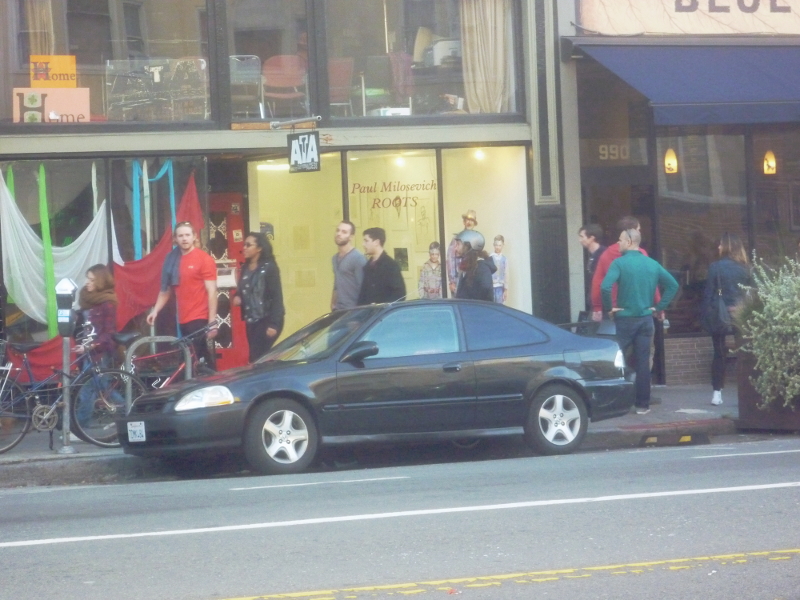
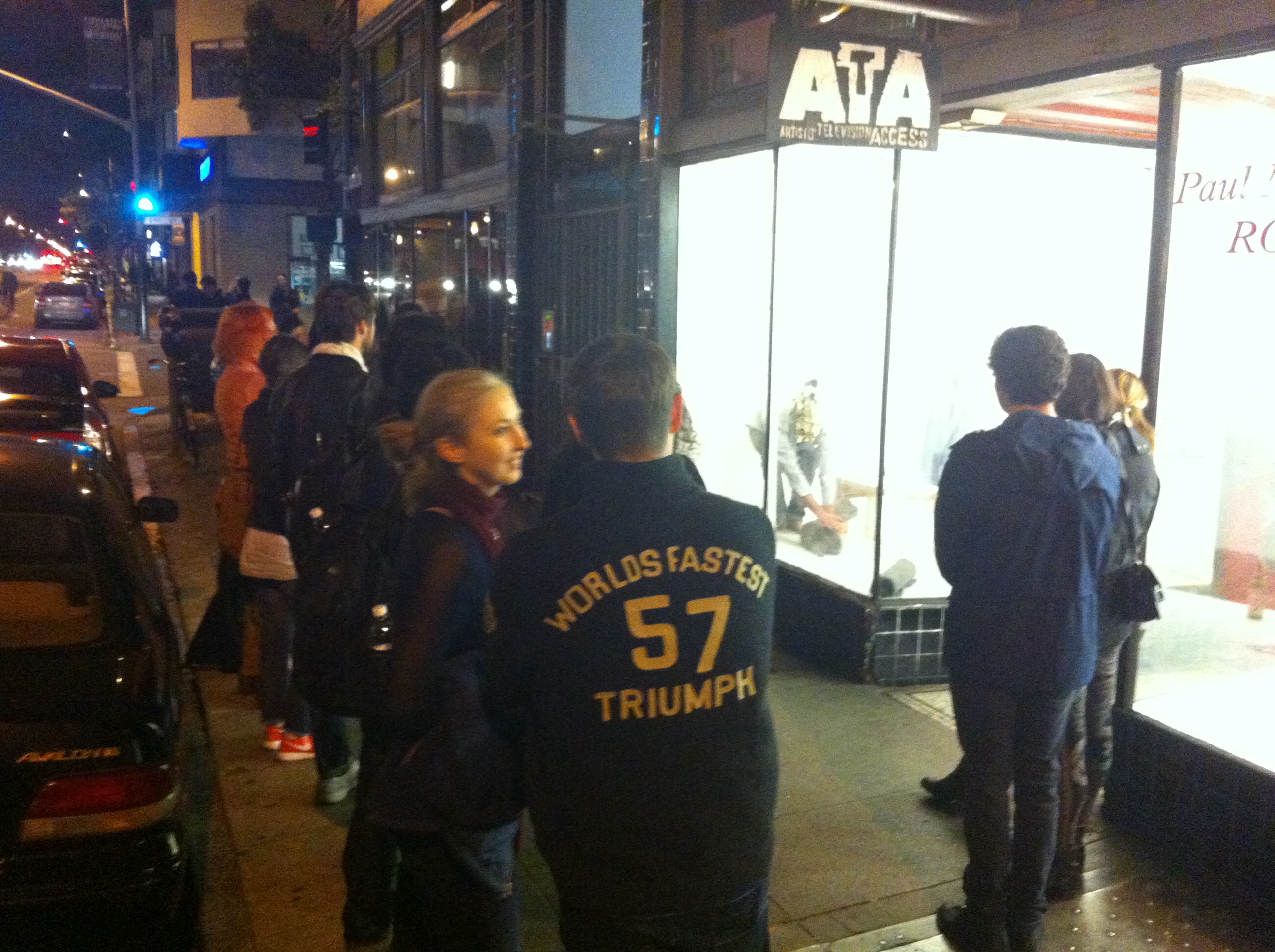
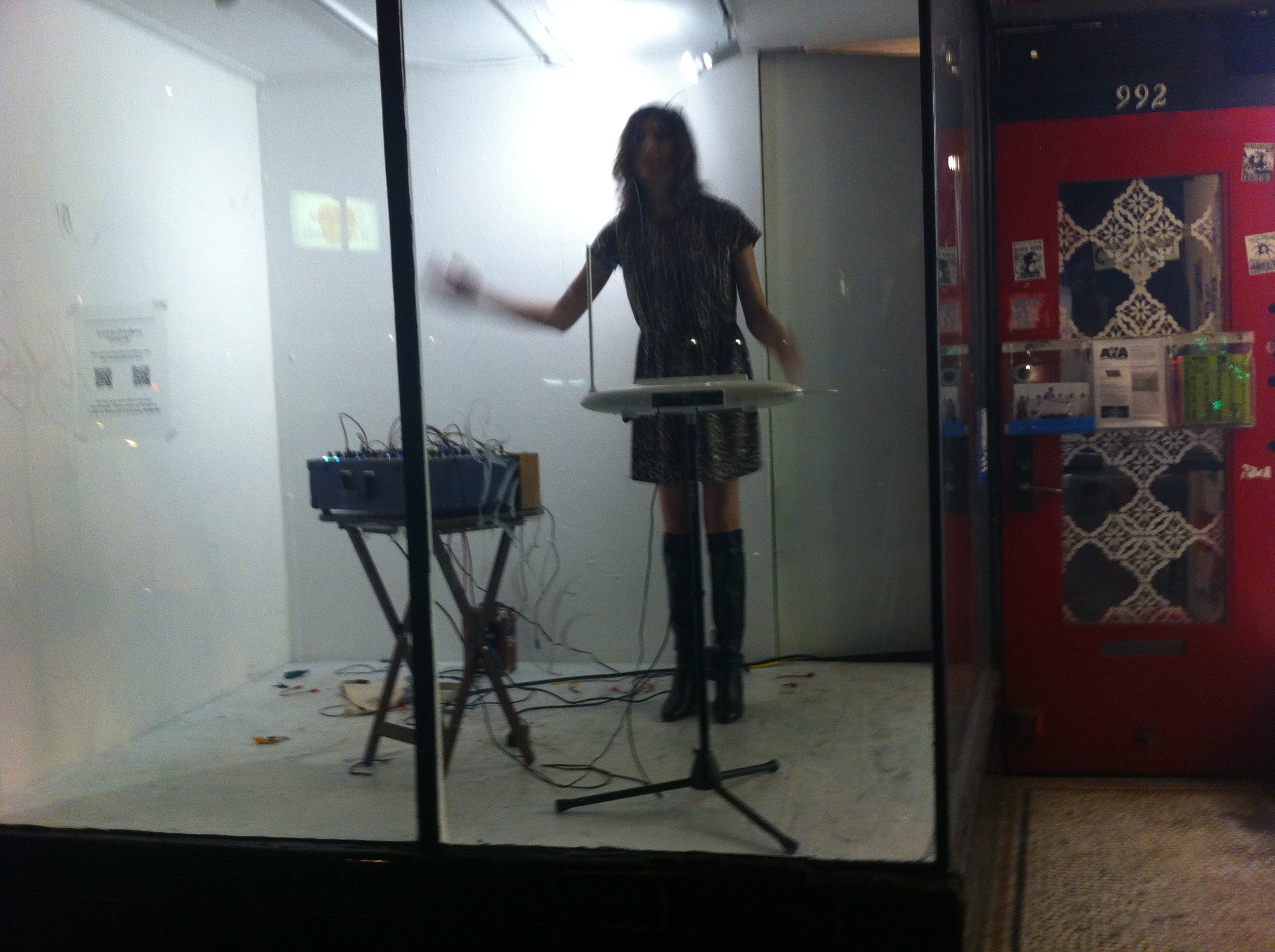
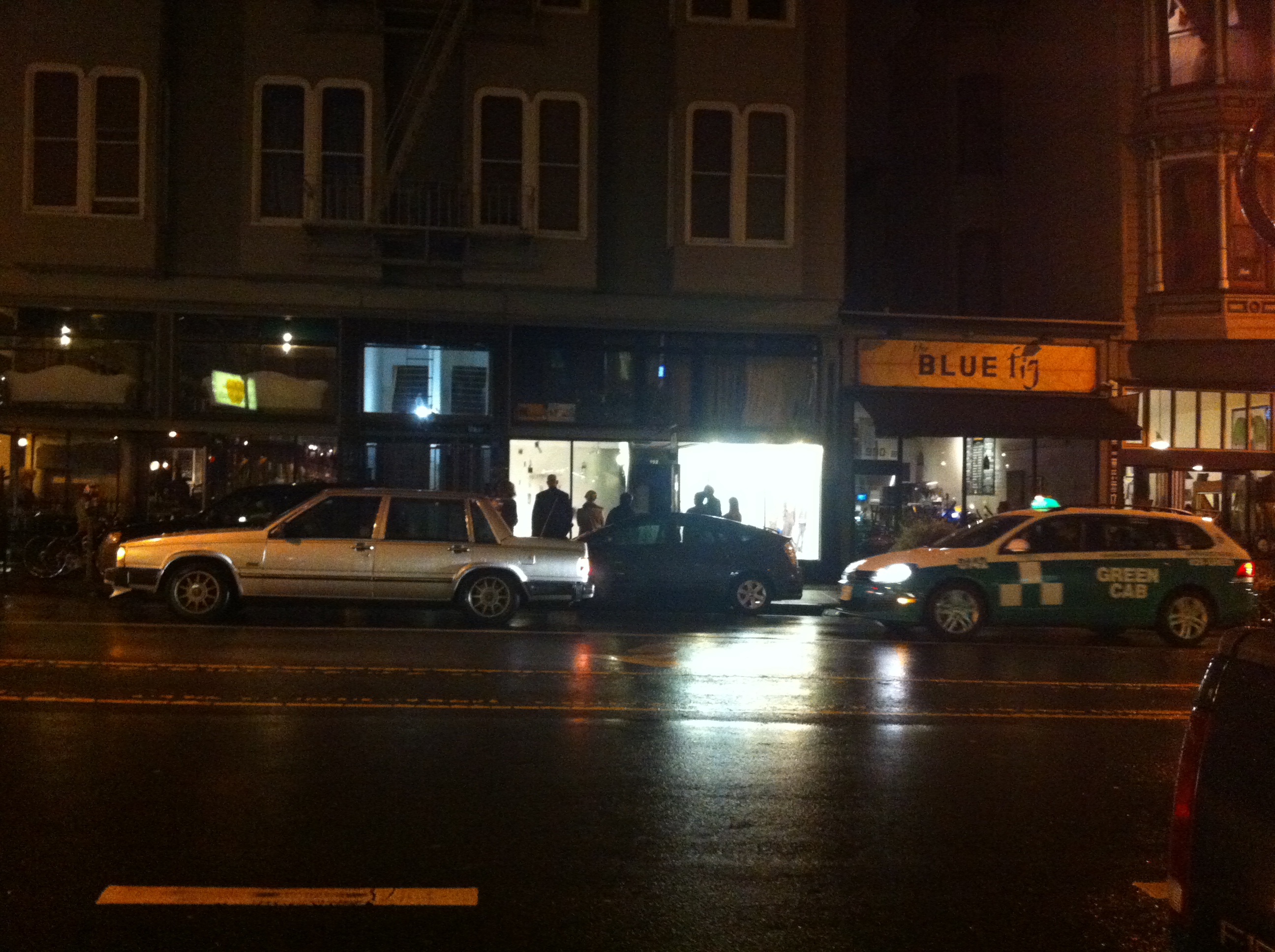 For the month of November, 2014, ATA’s window was animated by daily inhabitancies. Each day, a different artist or group of artists installed themselves in the storefront window, occupying it for a range of one to 48 hours. Their actions varied from just being there to performing music to outraged/ous splattering of substances. In the words of the ATA Window Gallery curators it was “a series of installed performances ranging from movement to musical, ritual to reenactment, interactive to endurance.”